


The Latin American delegation experienced both the resistance and the historical ties shared with this African nation, as well as pre-colonial lessons regarding the mystical relationship that the practitioners of Vodun maintain with nature. (Images: Baiano and Brazilian Collective at the 2026 World Social Forum in Cotonou, Benin)

BY RITA FREIRE, of Ciranda and the International Council of the World Social Forum.
The World Social Forum (WSF) has faced setbacks before—most notably in 2011 in Dakar, Senegal, when a new rector took charge of the University of Senegal, leading to the loss of previously scheduled venues. The affected organizations managed to overcome this through determination and creativity: they set up tents, secured vacant classrooms, and reorganized the entire event, using hand-drawn signs and arrows scattered across the campus to point participants toward the new locations. Yet, nothing compares to what unfolded in Cotonou, Benin, during the 2026 edition. Following a series of vague and confusing messages—which hinted at issues that were equally unclear and unrelated to the local organizing committee—the news struck like a bombshell: the 2026 WSF had been canceled—or, more accurately, prohibited by the government—on the very day it was set to begin: August 4th.
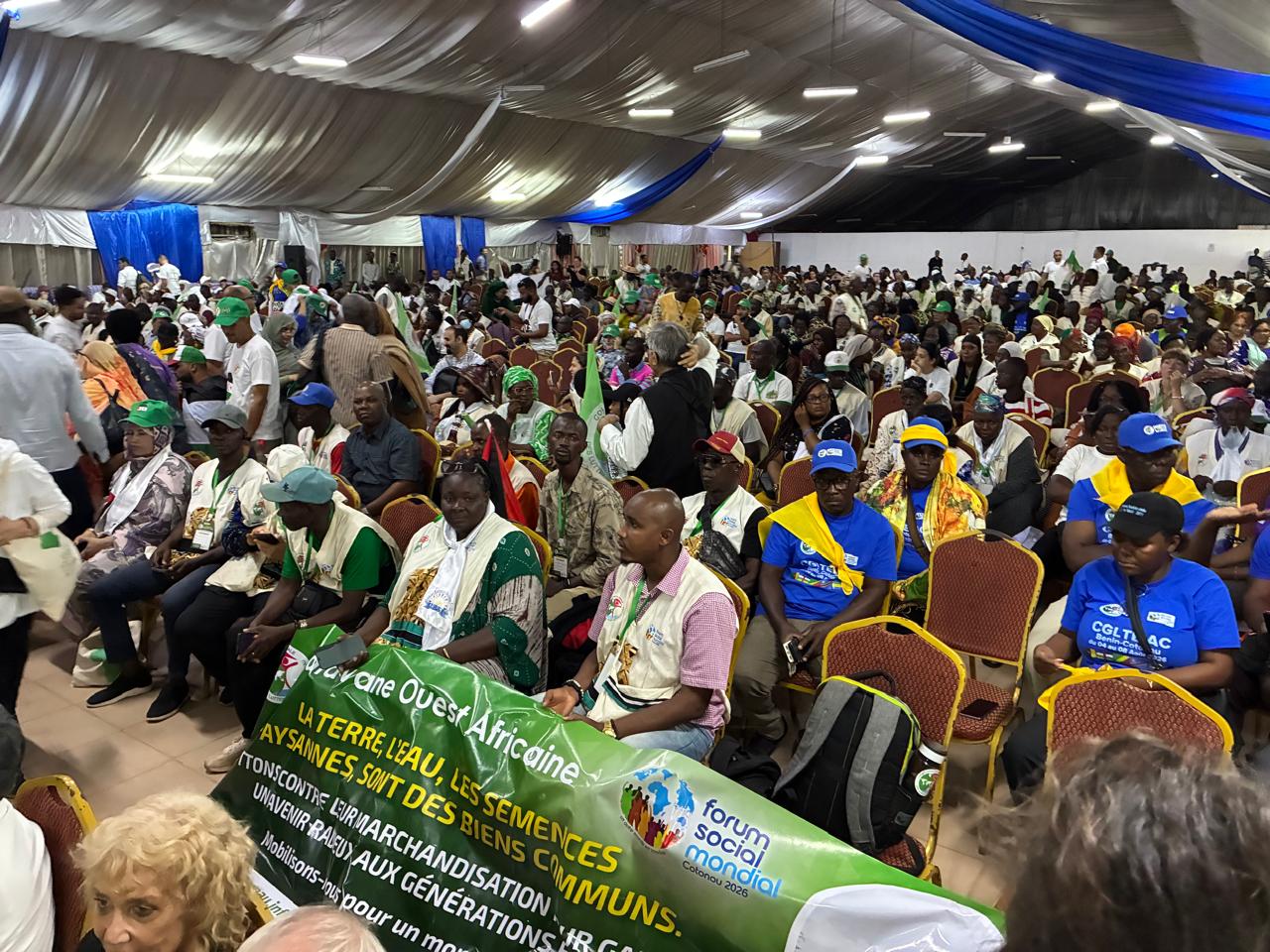
A crucial detail in this crisis is that preparations for the 2026 forum began during the final stretch of one administration, while the event itself was slated to take place under the next. Since the new president was a former minister backed by his predecessor, a continuation of the same political line was expected. However, shifts have occurred since he took office this year—most notably, a ban on marches and protests in the city’s public spaces. If a World Social Forum without a march is already inconceivable, the situation in Benin took this impossibility to an entirely new level. The World Social Forum (WSF) in Cotonou was conceived essentially as a grand convergence of marches arriving from Central Africa—with activists from countries such as Cameroon, Equatorial Guinea, the Central African Republic, and the Democratic Republic of the Congo—and from West African nations, including Nigeria, Senegal, Mali, Burkina Faso, Guinea-Bissau, Ivory Coast, Ghana, and Togo. They brought with them African struggles concerning water, land, the climate, and social justice, seeking to join forces with other movements organized on an international scale.
Tensions reached a breaking point when the caravans—which had crossed the Beninese border without incident and were led by the CGLTE (Global Coordination of Struggles for Land and Water), the primary organizer of the WSF—were stopped 100 km further inland and forced to leave the country.
Tension and resistance
The atmosphere that emerges when democratic space is shut down evokes the specters of repression—haunting anyone who has lived through a dictatorship—and heightens the sense of risk for movements fighting for rights and freedoms, such as those that gather at the WSF. Even meetings held in Cotonou hotels took place in an environment thick with a sense of alert against surveillance. Yet, these same specters also stirred the defiant spirit of resistance, prompting people to take action.
As individuals were being turned away or deported at the airport—fueling widespread indignation—and the university hosting the WSF kept its rooms locked while police patrolled the campus, organizations from Latin America—including those from Brazil, Colombia, Mexico, Chile, Nicaragua, and Haiti—convened on their own initiative. They asserted that the Forum does not belong to any government and that it could not, in political terms, resign itself to the silencing of social struggles—a trend that is increasingly becoming the norm across the globe. The International Council itself would need to re-examine its role in order to support a process that is urgently needed to counter the advance of the far-right everywhere—a movement that appeared to be baring its teeth in Benin.

Other activities and gatherings took place on the 4th and 5th in alternative spaces, keeping the World Social Forum (WSF) alive in some form, while African organizations engaged with various ministries and government offices, pushing to overturn the ban. By the end of August 5th, following a meeting of the Council of Ministers of Benin, news arrived that had seemed almost improbable: the bans were lifted—without much explanation—and the caravans set off once again, crossing borders. The university campus was officially opened for the event, and the 2026 WSF was finally welcomed in Cotonou. Despite a two-day delay, the edition began on August 6th with one of the most impactful opening ceremonies since the forum’s inception in 2001—marked by the arrival of the caravans, embraced by international movements.

In the days that followed, with everything being reorganized, the World Social Forum (WSF) took over buildings, auditoriums, classrooms, and lawns, while participants gathered in circles on the bare earth. Reviving another WSF tradition, informal workers were—to their relief—able to sell the street food they had prepared for the event. These offerings, hallmarks of the solidarity economy, included dried mango slices, pressed sesame bars, bottled water, and green coconut water—all highly sought after in the intense heat.
A smaller turnout, yet a strong defense of the WSF: The WSF in Benin received less support than anticipated from countries within the African diaspora—most notably Brazil, whose history is deeply intertwined with that of this African nation. At least a quarter of the enslaved people who came to form the Brazilian population originated from this region; conversely, many who were expelled from Brazil or had gained their freedom returned there, establishing a community that still identifies as “Brazilian” on the other side of the Atlantic. Just over a year ago, the government of Benin enacted a law granting citizenship to anyone who can prove descent from enslaved Africans in the diaspora—whether their ancestors came from Benin, Nigeria, Angola, or Senegal.

The country’s open arms and plans for a major gathering of Brazilians—both from home and abroad—did not translate into official support for a significant delegation, as had been the case in forums held during the previous decade. Organizations from the state of Bahia even held a preparatory meeting at the Federal University of Bahia less than a month before the World Social Forum (WSF), but ultimately ended up observing the turbulence and resilience of the WSF from afar. A small group managed to reach Cotonou—about seven people supported by a project from Unisol (a network of solidarity economy organizations funded by the Banco do Brasil Foundation)—along with three others who arrived through their own respective organizations: the Sem Fronteiras network, the environmental group Arayara, and the publication Fórum 21, which covered the event. Representing Brazil on the WSF International Council were members of the organizations Vida Brasil, the National Confederation of Black Entities of Brazil (Conen), and Ciranda Comunicação Compartilhada, in addition to Unisol itself.

Activists from Colombia were also preparing an initiative to support hosting a future global edition of the World Social Forum (WSF) in their country—which is now governed by a representative of the radical right. Their small delegation joined forces with the Brazilian delegation and representatives from neighboring countries to carry out a coordinated action in support of the WSF, amidst the turbulence of the first few days in Cotonou.

The four Brazilian members of the IC, three from Colombia, Mexico and Chile established an immediate dialogue between Latin America and the collegiate while the crisis disputed and threatened the very destiny of the WSF process.
The reflections and warnings present in his Letter to the IC of August 5, 2026 contributed to the decisions taken at the final meeting, on August 11, to formalize the discussion process on the role of the WSF in the face of the situation of closing freedoms in the world, re-discussion of its international secretariat and, also, the return of a centralized WSF for Latin America – where the resistance of civil society demands the FSM as a space to confront fascism on the continent.

The World Social Forum (WSF) program that survived the initial upheaval ensured that major debates took place—covering the defense of the planet, the struggle against wars, and the decolonization of the Global South—with the Brazilian Black movement represented by Gilberto Leal, coordinator of CONEN (National Coordination of Black Entities). During a joint session focused on fostering international connections among movements opposing the genocide in Palestine and the Israel-U.S. wars in the Middle East, several Brazilian initiatives were highlighted, including the Latin American-Palestinian Forum, the Middle East Monitor, the Shireen Abu Akleh Collective of Journalists, and the Palestine Front (São Paulo). The Forum also paid tribute to Ahmad Jaradat, a journalist with the Palestinian Forum who passed away a month ago; his articles on Jerusalem and the Israeli occupation had been translated into Portuguese and circulated in Brazil.

Hybrid activities were rendered unfeasible due to general delays that prevented the equipping of spaces rearranged for the World Social Forum (WSF)—including a small Brazil-focused booth. Remote participation in debates was also hindered, affecting online guests who were set to contribute to discussions on the data control exerted by “Big Tech” companies, as well as the exploration of secure alternatives for social movements. A joint meeting on independent media, convened by the Colombian delegation, focused its discussions on grassroots political communication strategies to counter fascism; a follow-up meeting was scheduled for the following month to further develop these initiatives.

The World Social Assembly—which ultimately took place outdoors with a smaller group than anticipated—was one of the few sessions that managed to improvise a connection with participants from abroad. These participants joined via a Zoom room, supported by interpreters in four languages, effectively extending the event beyond the in-person circle gathered on the packed-earth ground. The assembly featured expressions of solidarity with Cuba, the Congo, Haiti, Western Sahara, and Palestine, as well as protests against deportations that occurred during the days surrounding the World Social Forum (WSF). Several activists—from Scandinavia, Germany, Haiti, Russia, and Uganda—were denied entry upon arrival at the airport and sent back via Ethiopia.

A journey into the history of Brazilians who returned home

The Brazilian delegation, led by Gilberto Leal, undertook two excursions into the heart of Benin, exploring historical and ancestral sites that became an integral part of their experience during the 2026 World Social Forum (WSF). One day was dedicated to visiting the homes of the agudás—the “Brazilians” who returned to Africa. These individuals are descendants of both enslaved people and the slave trader Francisco Félix de Souza. Their collective memory is complex: some are direct descendants—tracing their lineage to the roughly 80 children he fathered with 53 different women—while others simply bear or revere the surname of the man who was the most prominent human trafficker in the slave trade between Brazil and Africa during the 18th and 19th centuries.
During the visit, it was impossible to reconcile the starkly different perspectives on this criminal trafficker: the view held in Brazil versus the recognition found among the “Brazilians” of Ouidah. In a profound contradiction, this man—who likely trafficked many of the very people who later returned—also served as a source of refuge and protection for former slaves, while playing a pivotal role in shaping the destiny of the Kingdom of Dahomey.
The courtyard of the restored grand house of Francisco Félix de Souza—around which the city of Ouidah grew—offered a disquieting experience for the Brazilian visitors. It felt, in part, like a tribute to a man who traded in human beings; this impression was compounded by the presence of statues—still partially wrapped—depicting enslaved people in agony, held captive by their masters, and subjected to iron shackles and the torture of restraints.
Beyond the de Souza family—who occupy a cluster of homes in the surrounding town, divided among various branches of the original lineage—the delegation also visited or observed the residences of other families, including the Almeidas, Oliveiras, and Costas—surnames adopted by those who returned. In each instance, they encountered “Brazilians” who continue to uphold their ancestral traditions, festivals, and celebrations.
The memory of those who did not return, and the female warriors of Dahomey

The government of Benin has been preserving and transforming sites linked to the history of slavery into destinations for visitors. Among these are two trees that hold symbolic significance regarding the departure of trafficked Africans—trees touched by these individuals before their forced embarkation: the “tree of the promise of the enslaved person’s spirit to return to their homeland,” and the “tree of forgetting,” intended to help them endure a journey from which there would be no return in their lifetime. A symbolic “gate of no return” has also been installed on the sands of the main beach in Cotonou.
See Also: The far-right militarizes the fight against crime with the “Shield of the Americas”
Perhaps the most inspiring feature of this historical circuit is the statue of the Amazon—a 30-meter-tall figure representing a warrior from the Agojie, the only all-female African army and the most feared force in the region. They were responsible for protecting the Kingdom of Dahomey. By honoring the female strength that secured the kingdom’s defense, this monument—now a symbol of Benin—encourages visitors to delve into history to understand how slavery was woven into the relationships between the region’s various peoples. Enemies defeated by the Amazons became the property of the king; many were sold to Francisco Félix de Souza in exchange for goods such as alcohol and tobacco—commodities that likely ended up in Brazil. Eventually defeated by France—which demanded control over the port and commercial privileges—the end of the Agojie (who had confronted the overwhelming power of French machine guns with nothing but machetes and hand-to-hand combat) also marked the end of the Kingdom of Dahomey and the beginning of the colony known as Benin.
Nature as a divine force: a religious tradition
Benin, now governed under a republican system, remains a vital hub for Vodun culture—a tradition akin to Candomblé in Brazil and Voodoo in the Caribbean—while also preserving strong Yoruba influences, such as those of the Keto people of Benin and Nigeria. Within a nature reserve revered as a “Sacred Forest,” one finds sculptures of orixás—deities from the Yoruba tradition—crafted from recycled materials and scrap metal. These figures stand among trees that shelter areas reserved exclusively for spiritual leaders. These are the same orixás—though depicted with different aesthetic forms—that are worshipped in various terreiros (places of worship) throughout Salvador, Brazil.
Distinct from what is typically found in Brazil or the rest of Latin America is the “Python Temple,” home to snakes native to the region, which are considered sacred. Here, visitors can have their photographs taken with live snakes draped around their necks—an experience shared by the Brazilian delegation—and subsequently seek purification within structures featuring low-set entrances, requiring visitors to bow down as they enter, a gesture signifying humility.
One of the temple guides explained that Vodun is, in essence, pure ecology; it involves no entities or powers other than those of nature itself and the relationship between human beings and these natural forces. “If we harm people, cause injury, obstruct a path, or disrupt the flow of nature, it reacts against us. If we respect it, it protects us. Everything is interconnected,” the guide explained.
Traditional Chiefs Connect the “Deep Benin” to the WSF
Vodun has other homes in Benin; one of the most fascinating is the stilt village of Ganvié, located on Lake Nokoué and accessible only by boat. In the same watershed lies the traditional kingdom of Wémé-Tosso. The World Social Forum (WSF) in Cotonou brought these and other traditional peoples directly into the civil society event by involving the region’s traditional leaders—its kings—in the planning process over the past two years. Preparatory meetings were consistently graced by their presence and words, allowing for a meaningful integration between the WSF and local culture.

Leaders of ancient kingdoms that predated European colonization in Dahomey (present-day Benin and Nigeria) have maintained a line of succession and continue to hold moral, ethical, and spiritual authority among the peoples their ancestors once ruled. While they no longer possess institutional political power, they serve as guardians of culture and remain active, revered traditional authorities. Among the monarchs representing pre-colonial Benin at the 2026 World Social Forum (WSF) was the King of Wemé-Tosso—Tossoholou Zoundjè Wandji Ganmasizo Toli Yélian—who serves as the supreme leader and grand sorcerer of the Tossos Ayatô–Ganmenou.

His kingdom lies along the banks of the Wémé River, which flows directly into Lake Nokoué—the site where the floating city of Ganvié was built. In July 2022, he officially joined the High Council of Kings of Benin (HCRB), an organization that brings together the country’s traditional authorities to discuss matters concerning their people and culture.
The King of Ganvié—from the Tofinu ethnic group—Missikpo Yoka III Azinkpodoté, is also a member of the Council. Both leaders advocate for the interests of the river and lake communities before the government, while also safeguarding their traditions and the reciprocal trade between fish from the lake and food crops from the land. It was at the personal invitation of King Tossoholou Zoundjè that a group—comprising five visitors from Brazil, two from Mexico, and one from Nepal—traveled by boat across Lake Nokoué, accompanied by the Queen of the Tossos, Tata Simenvo. There, they encountered one of the most impressive examples of sustainability in fish production: an ancestral technique known as acadja, which serves as the foundation of the local economy.

These practices were adopted by the Tofiné people when they built houses on stilts over the lake’s waters to escape the army of Dahomey, which sought to enslave them. According to local history, the forces of Dahomey harbored a spiritual fear of the water; thus, living upon it became the key to the Tofiné’s survival. In fact, the name “Ganvié” itself means: “we saved” (gan) “the community” (vié).
To ensure an abundant supply of fish—both for local consumption and for sale at the market in Cotonou—the Tofiné employ a technique known as acadja. This involves driving bamboo stakes into the bed of the shallow lake to create enclosures, into which branches and softer, decomposable plant matter are placed. These materials attract and feed the fish—primarily tilapia—while the bamboo structures also serve to protect them from predators. At the end of each cycle, the fish are harvested for local consumption or sold in Cotonou. The enclosures are then either refreshed or relocated to allow the lake bed to recover. As no artificial feed or external, non-natural substances are used, these fish are considered the healthiest and most highly prized in the region.
While explaining how this natural form of fish farming works, the King of the Tofiné promised to compile information and knowledge regarding the technique and share it with the World Social Forum (WSF) through the visiting delegation. “This is knowledge now in your hands to carry forward,” he said. His offer prompted an invitation from a Mexican group for the King to join a research network established in Latin America, which focuses on agroecology and other post-capitalist studies. An enthusiastic proponent of intercontinental exchange, the King also pledged to bring other traditional leaders into the network, as they serve as custodians of a wealth of ancient wisdom.
Ganvié possesses the full infrastructure of a town—ranging from a maternity clinic and schools to lodging and a wooden restaurant, where the group enjoyed lunch and spoke with the royal couple. Although referred to as a great sorcerer, the “king of the tossos” reaffirmed the ecological nature of Vodun, in which the entities are spirits of nature rather than supernatural beings.
He noted, however, that certain natural substances grant sorcerers the ability to see great distances—even as far as Brazil—and offered predictions for the country for this year: he asserted that Lula is already the victor. The queen, who favors fish heads—believing them to be good for one’s intelligence—ate her tilapia with her hands, in keeping with local custom, and gladly accepted the other head from the king’s plate. Cheerful and lively, she laughed heartily while speaking of her children, clearly taking pride in her family. The king, for his part, praised the strength and beauty of this mother of five, declaring that he could not reign without her. It falls to traditional leaders to uphold a sense of justice within the community; yet, the presence of these “majesties” as they traveled across the lake or entered the restaurant did not elicit any particular displays of reverence. They are simply an integrated part of everyday community life.

The delegation was unable to visit the royal household because an International Council meeting in Cotonou was set to begin late Sunday afternoon, and they needed to arrive on time. The traditional chief was given a seat of honor at the meeting table, where it was decided that the responsibility for the next forum would be handed over to the Latin American representatives on the Council—a group composed primarily of women. “We will be there,” the couple promised, in the event that a World Social Forum (WSF) is held in Salvador, Bahia.

On the way to the meeting point, while still navigating the lake, it was possible to witness another aspect of life among the “water people”: it was market day in this aquatic town. Small boats—steered primarily by women—traveled between the floating market and the homes, structures, and watery alleyways seen throughout the tour of Ganvié. Other small craft also headed toward the port, where they gathered to drop off and pick up people and goods for trade. “The women are the strength of Ganvié; they drive its economy,” the royal couple explained. As they crossed paths with the visitors’ boat, the rowed canoes could be seen carrying small loads of flour, bananas, tins, and sacks of food—provisions for another week of communal life for the people of the kingdom of Ganvié.
The following individuals participated in the Brazilian delegation to the World Social Forum (WSF) in Benin:
– Unilsol Bahia: Anne Sena, Aline Sena, Anderson Cardoso, Danilo Sodré – Bahia
– Vida Brasil: Damien Hazard, Islândia Costa – Bahia
– Conen (Coordination of Black Entities/Brazil): Gilberto Leal – Bahia
– Centro Palmares de Estudos e Assessoria por Direitos: Danilo Moura – Bahia
– Soweto Organização Negra: Alva Helena de Almeida, Vanderli Salatiel – São Paulo
– Ciranda: Rita Freire – São Paulo
– Arayara: Fernando Caixeta – Federal District (DF)
– Rede sem Fronteiras: Paulo Iles
– IPS/Fórum 21: Tatiana Carlotti – São Paulo
Participants from the Colombian delegation included:
Ximena Lucelly Sanchez Cortes, from Obusinga—an organization that advocates for the organizing of rural communities (peasantry) and the protection of ecosystems.
Jaime López, from Fundación Palco – La esquina de la radio—an organization focused on alternative, grassroots communication, featuring radio networks and community-based communication initiatives. María Leonor, national agrarian coordinator CNA Colombia, peasant movement
Aura Rodríguez, Viva la ciudadanía, entity of investigation, action, human rights and education.
Víctor Correa Lugo, specialist in the Middle East, writer and political advisor
Mario Gil de Ceaal – Latin American and Caribbean popular education network
Mexican delegation
Rozy Zûniga, from Ceaal – Latin American and Caribbean popular education network
Delta Argelia Torres Rivera – Red de Estudios del Postcapitalismo.
Visited Ouidah:
Brazil: Anne Sena, Aline Sena, Anderson Cardoso, Danilo Sodré, Damien Hazard, Islândia Costa, Gilberto Leal, Rita Freire, Fernando Caixeta, Paulo Iles, Tatiana Carlotti
Canada: Michel Lambert
Visited Ganvié:
Brazil: Damien Hazard, Islândia Costa, Gilberto Leal, Rita Freire
Mexico: Rozy Zûniga and Delta Argelia Torres Rivera
Nepal: Tikaswari Rai
Upcoming activities
Plenary session of the Bahia and Brazil collectives of the WSF (World Social Forum)
Wednesday, August 26 · 11:00 AM – 12:30 PM
Time zone: Brazil
How to join via Google Meet
Video call link: https://meet.google.com/kgx-uvns-kjc
Or dial: (FR) +33 1 73 08 31 91 PIN: 709 775 344 0497#
Other phone numbers: https://tel.meet/kgx-uvns-kjc?pin=7097753440497
Latin American Independent Media Gathering – September 2026 – Date to be confirmed
World Social Assembly meeting – Date to be confirmed
WSF International Council meeting – Date to be confirmed